

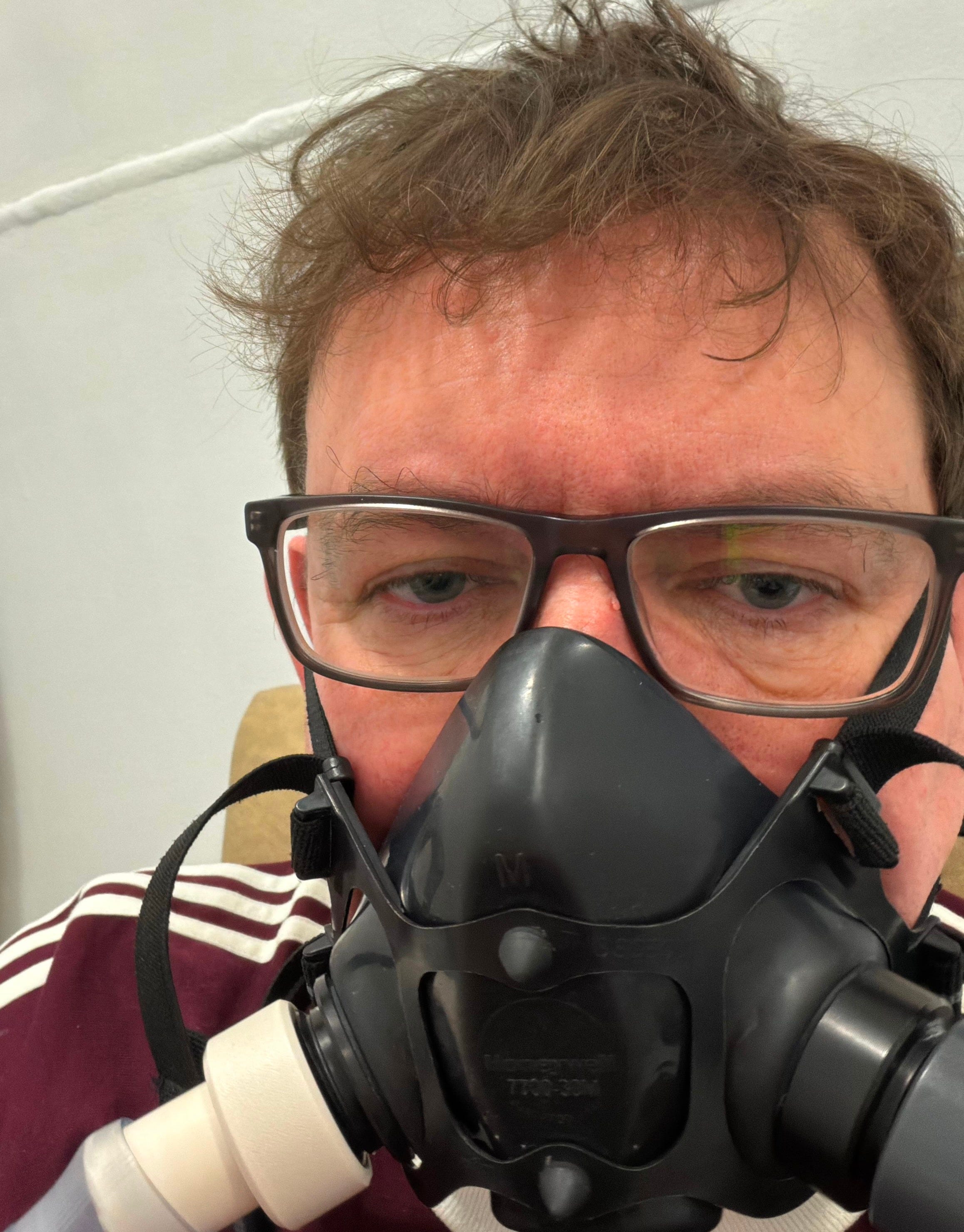
Last week, I thought I might be getting my life back.
Not in a dramatic way. Nothing like waking up suddenly cured. But there was a shift during my second week of 24ft oxygen therapy. A lightness, a sense that something had moved. My brain felt clearer, my body more willing, and I was doing more without paying quite so much for it afterwards.
And quietly, perhaps more quietly than I realised, I began to celebrate.
I didn’t say it out loud, but somewhere underneath it all, I think I allowed myself to believe that this might be it. That I had turned a corner. That the oxygen therapy was the thing that had finally unlocked something. That this might be the beginning of the end.
This week has been different.
Not dramatically worse, not a crash, but a definite step back from that fragile sense of momentum. I’ve been more tired again—the chronic kind of tired that sits behind your eyes and slows everything down. The kind that makes even simple decisions feel heavier than they should.
The brain fog is still better than it was before all this started, which is huge. That improvement has held, and I’m grateful for that. It has been very helpful for my writing. And I’m still more mobile than I was, just not quite as much as last week—and that contrast is hard.
I’ve found myself asking the question that I imagine many people with long-term conditions ask over and over again: Is this working?
Is the oxygen therapy helping, or was last week just a good week? Is this progress, or just fluctuation dressed up as hope?
The honest answer is that I don’t yet know, at least not until my baseline becomes clearer again. And that uncertainty is, I think, one of the hardest parts of living with something like this.
When you’re dealing with an illness that follows a clear path, there’s actually a strange comfort in it. You know what stage you’re in, you know what comes next, and you know roughly what “better” is supposed to look like.
But long Covid doesn’t work like that.
It moves in increments and fragments, in what feel like ‘almosts’. You get a glimpse of something better, and then it shifts again. Not always backwards, but frustratingly not cleanly forwards either.
If I’m honest, the biggest challenge this week hasn’t been the physical symptoms. It’s been the mental adjustment.
Last week lifted me and, if I’m being honest, filled me with more hope than was realistic. This week has required me to steady myself again, because hope, when it rises quickly, can be disorientating when it settles. You don’t just lose energy—you lose expectation, and that can be harder to process.
I can see now why chronic illness and low mood so often sit side by side. Not because people are weak or negative, but because this constant recalibration takes its toll.
You are always adjusting what you can do, what you expect, and what you allow yourself to hope for. And if you’re not careful, that quiet erosion can begin to wear you down.
I’ve had to remind myself of something this week—something I knew already, but clearly needed to learn again.
Improvement, if it comes, will not arrive all at once. It will come slowly, in small and sometimes almost unnoticeable shifts over time. And those shifts won’t be linear. There will be better days and heavier days, weeks that feel like progress and weeks that feel like a pause.
That doesn’t mean nothing is happening. It just means this is how it works.
So I’m trying to reframe things, not as “last week was success and this week is failure”, but as part of a longer process that I can’t yet fully see.
The brain fog improving still matters. The increased mobility still matters. Even if they fluctuate, they are not nothing. They are signs, just not guarantees.
I’m continuing with the oxygen therapy, and I’m also taking antihistamines again, which have helped with fatigue in the past. Whether that’s coincidence or causation, I honestly don’t know, but when you’re navigating something like this, you pay attention to anything that seems to help, even slightly.
And yes, I’ve managed to sort all of this without actually speaking to a doctor, which probably says something about the strange, self-directed world many of us with long Covid end up living in.
You become your own researcher, your own trial-and-error experiment, and your own cautious optimist.
But perhaps the most important work isn’t physical at all. It’s learning how to hold the tension: to allow hope without letting it run too far ahead, and to acknowledge setbacks without letting them define the whole story.
Because the truth is, something is happening—even if it’s slower than I want, messier than I expected, and refuses to follow a neat narrative arc.
This week hasn’t taken everything away. It has just reminded me that recovery, if it comes, will not be simple.
And perhaps that’s the real shift. Not the physical improvement, but the understanding that I need to learn to live with uncertainty, not just wait for it to disappear.
If you’re walking a similar path, you’ll recognise this rhythm—the lift, the dip, and the quiet question of what now?
And maybe that’s where we meet. Not in certainty, but in persistence.
I’m still here, still trying things, still paying attention, still hoping—just a little more carefully this time.
Paul.
Life with Long Covid is more than a few articles; it is also:
A community which you can find at www.lifewithlongcovid.co.uk
A podcast which you can access through the website or through Apple and Spotify, just search for ‘Life with Long Covid’.
I have also produced a short book that details some of my podcasts in short, easily digestible chapters. You can read it when you have the energy. It’s available on Amazon here.
Sales of the book help cover the costs of the podcast and website. You can subscribe to receive the latest articles and episodes in your email inbox. This is free, but you can also pay monthly or annually to receive it. To the people who feel able to support me financially, I am very grateful.
“The silence is not empty.
The waiting is not wasted.
And even here, in the quiet, the story is still moving.”