

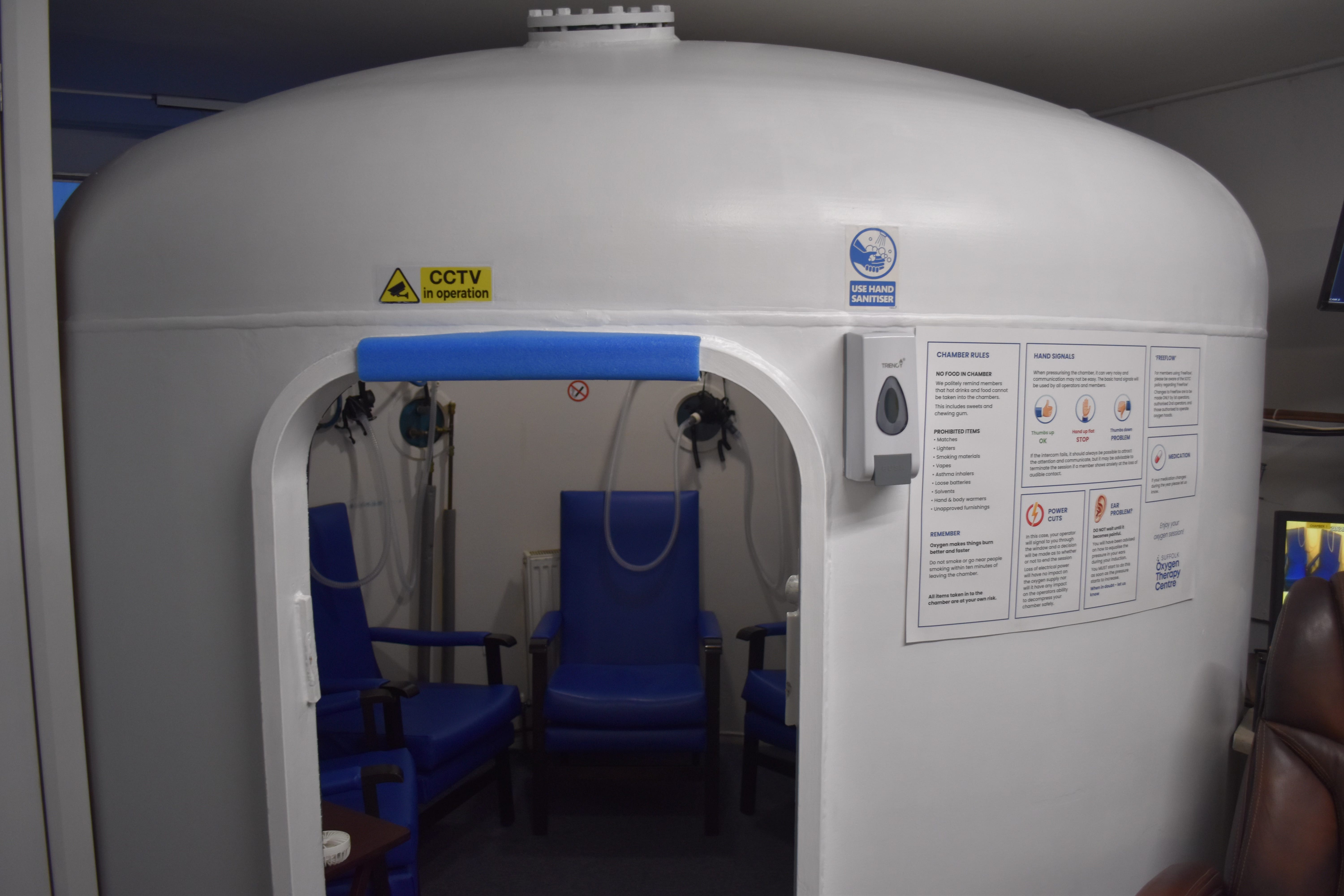
Yesterday, I found myself sitting inside what looks, quite convincingly, like a deep-sea diving chamber.
It’s small, round, and surprisingly human in scale. There are oxygen masks clipped neatly to the sides, space for around four people, and just enough room to sit comfortably without feeling cramped. As the big door is shut and the session begins, the sound of pressurised air fills the chamber. A steady whooshing that reminds you very quickly that something unusual is happening.
This was my first experience of high-dose oxygen therapy.
Going Down to 16 Feet
Because it was my first session, we only went to the equivalent of 16 feet in depth. I was told there’s no single “ideal” depth, sessions can go up to around 32 feet, and it’s a process of gradually finding what works for each person.
Nothing is rushed.
Beforehand, everything is carefully explained: what to expect, which sensations are normal, and what to do if you feel uncomfortable. At every step of the way, Mark and his staff were kind and considerate to me and my fellow first-time “divers”. That mattered more to me than I expected.
When the pressure starts to change, your ears pop, much like ascending in an aeroplane, but it was gentler than I’d anticipated, and we were warned at every stage. No surprises.
The Mask and the Moment of Doubt
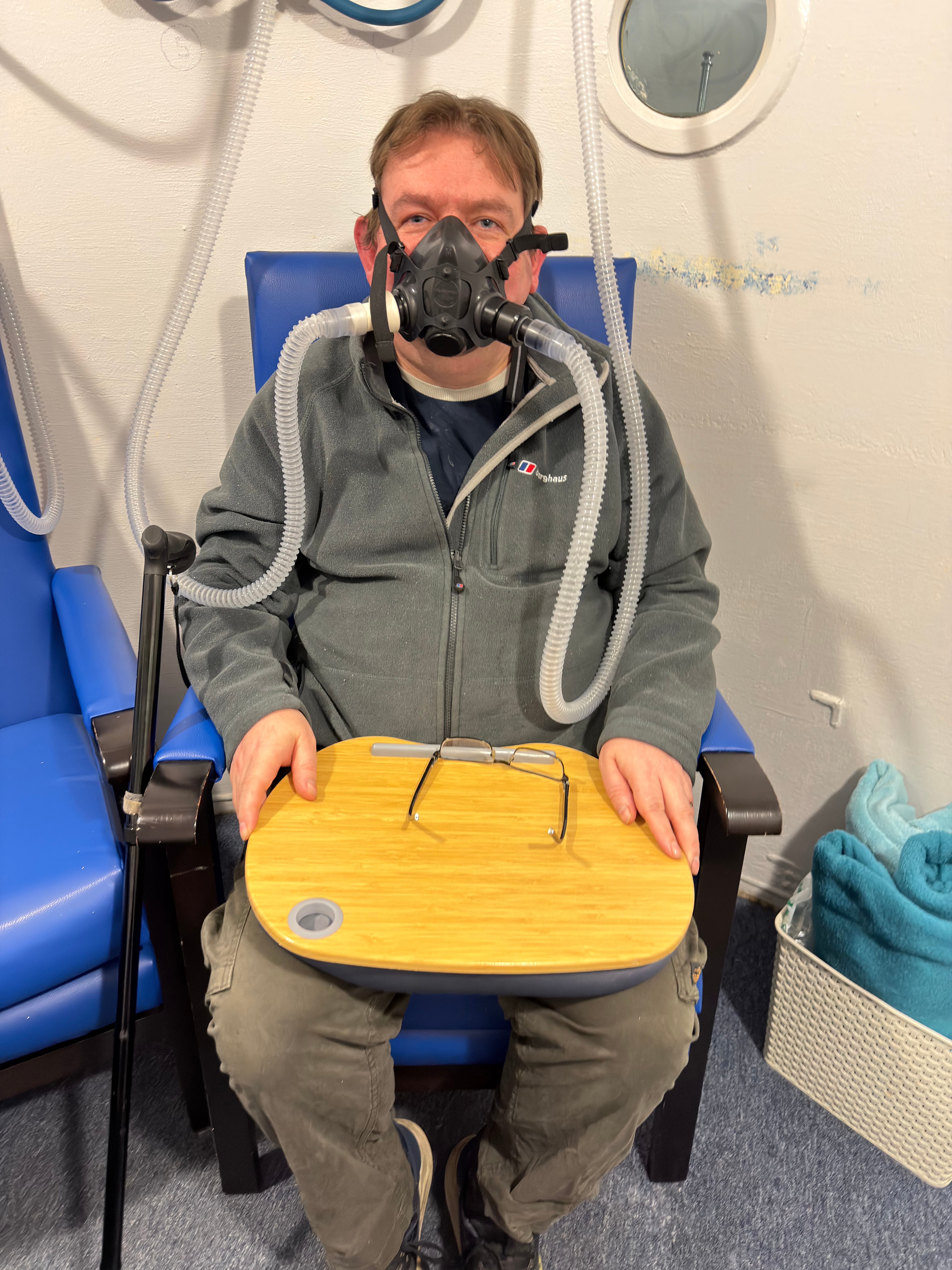
Once the oxygen mask goes on, I’ll be honest, it feels strange.
Looks-wise, there’s something slightly Top Gun about it, but without the cool factor. The mask is big, heavy, and unmistakably industrial. I’m used to wearing a CPAP mask every night, but this felt different. Breathing takes a little more effort at first, and there’s a moment where your body thinks, I’m not sure about this.
Then, slowly, something shifts.
As the minutes pass, your breathing adjusts. Your body acclimatises to the pressure, the oxygen, the unfamiliar rhythm. I noticed my shoulders dropping. My jaw unclenched. The initial alertness gave way to something calmer.
I felt fine. Slightly claustrophobic, perhaps, but not distressed. More aware than anxious.
Feeling Safe Matters More Than You Think
One thing that made a huge difference was the personal approach.
Mark, the manager, was in the chamber with us, guiding the newbies, keeping things light, and reassuring without being overbearing. His staff were always outside and checked on us every fifteen minutes via an intercom. Ever the writer, I even tried fishing for a few gruesome stories (as you do), but sadly, there weren’t any. Reassuringly dull, in the best possible way.
At no point did I feel unsafe.
That might sound like a small thing, but when you live with Long Covid, your body already feels unpredictable. You notice when you’re being properly looked after.
Afterwards: A Subtle Shift
When the session ended, I felt light-headed, but in a pleasant way. Clear rather than spaced out. Before I’d even left, I’d booked my next appointment.
The man sitting next to me had gone in looking pale and washed out. When we came out, the colour had returned to his face so noticeably that it was hard to ignore. It wasn’t dramatic, just a lot better. And sometimes, that’s enough to feel like a win.
One Day Later
I’m writing this the day after my first session, and I want to be cautious.
I’ve tried many things over the past few years to improve my Long Covid symptoms. Hope is a renewable resource, but it’s also one you learn to ration. I don’t want to get carried away.
That said…
I had a fantastic night’s sleep. Not just longer, but deeper. My watch recorded over an hour of deep sleep, something I haven’t managed for a very long time. Quantity and quality.
Yesterday evening and this morning, I feel unusually sharp. My brain fog, which is often my most stubborn symptom, has lifted significantly. Not vanished, but noticeably improved. Enough that I’m aware of the difference.
Is it a placebo? Is it a coincidence? Is it a short-term effect?
Honestly, I don’t know yet.
What I do know is that today feels different, and I’m journaling and paying close attention.
Cautious Optimism (The Only Kind I Trust)
I’m looking ahead to my next session on Friday, curious to see whether these effects wear off in the meantime or whether something begins to build. I’ll be documenting this properly and honestly, not just the good days, but the flat ones too.
If you live with chronic illness, you’ll understand this approach: hopeful, but grounded. Interested, but sceptical. Open, but not naïve.
That’s where I am right now.
A Word of Thanks
I want to thank Suffolk Oxygen Therapy, a company I didn’t even know existed until recently.
This is only the beginning. I’m not drawing conclusions yet.
But for the first time in a while, I’m cautiously and deliberately paying attention to the possibility that something might help.
And that, in itself, feels like a small step forward.
Watch this space for further updates.
Life with Long Covid is more than a few articles; it is also:
A community which you can find at www.lifewithlongcovid.co.uk
A podcast which you can access through the website or through Apple and Spotify, just search for ‘Life with Long Covid’.
I have also produced a short book that details some of my podcasts in short, easily digestible chapters. You can read it when you have the energy. It’s available on Amazon here.
Sales of the book help cover the costs of the podcast and website. You can subscribe to receive the latest articles and episodes in your email inbox. This is free, but you can also pay monthly or annually to receive it. To the people who feel able to support me financially, I am very grateful.
Interesting insights!- curious about your next sessions.. if it leads to a sustainable improvement maybe I give it a try.. hm.. better sleep at night sounds like heaven atm..:)