

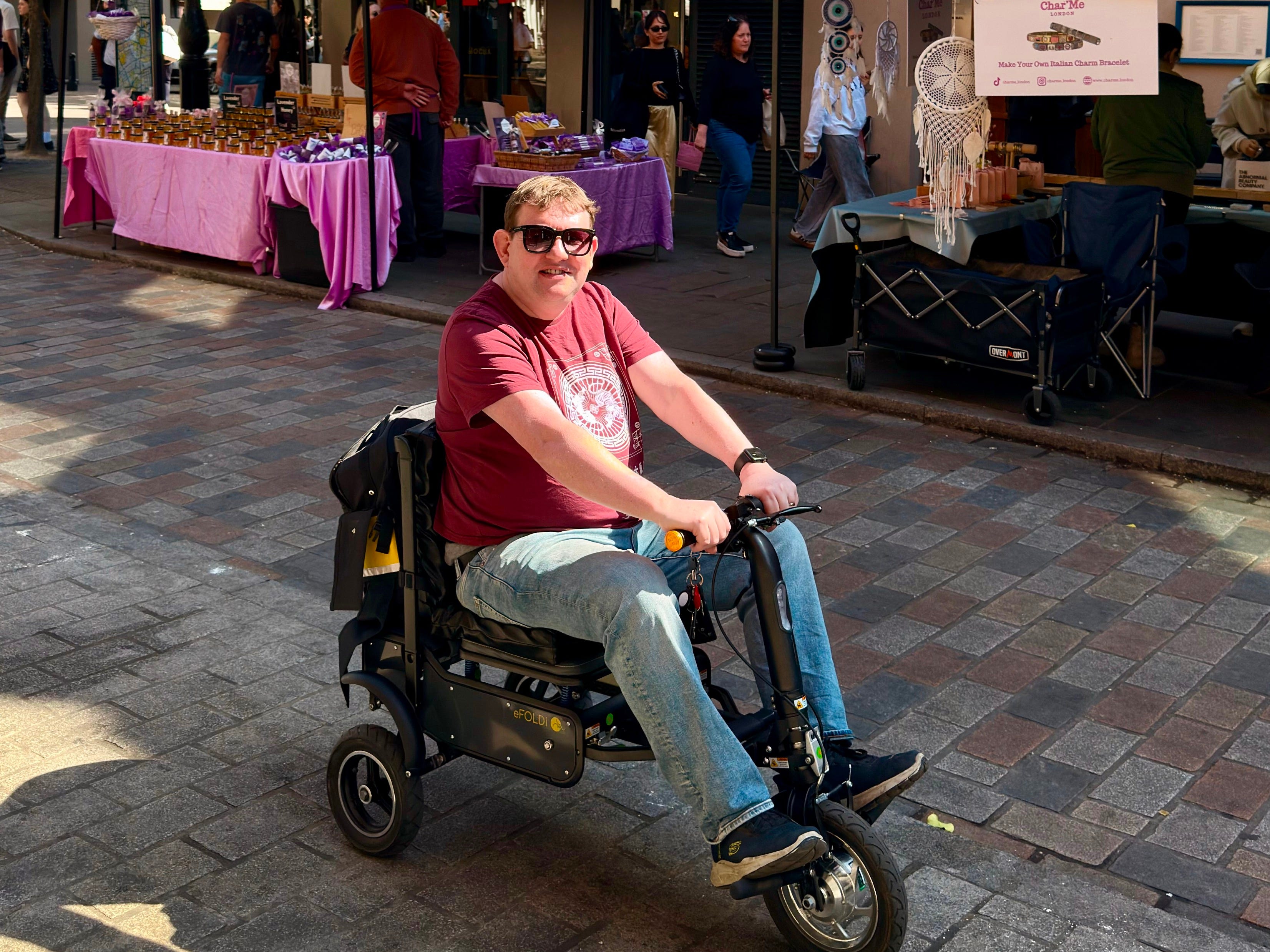
There was a moment, not that long ago, when I thought I might be done with them.
Not completely. Not dramatically. But quietly, subtly, as if I could just… move on.
Oxygen therapy had lifted my baseline. Not back to where it once was, but enough to make life feel a little wider again. A little more possible. And with that came a thought I hadn’t entertained for a while:
Maybe I don’t need them as much anymore.
Mobility aids have become part of my life over the past few years. Not by choice, but by necessity. They arrived gradually, then suddenly, then permanently. Each one marking a point along the journey where something had been lost… and something else had to take its place.
But now, with things slightly improved, I found myself resisting them.
Not in a dramatic way, just small decisions, repeated daily.
I’ll leave it behind today.
I’ll manage without it this time.
It’s not that far.
I’ll be fine.
In my head, this was progress.
In reality, it wasn’t.
The Quiet Experiment
For a few weeks, I pushed against using them.
I wanted to see what life would look like without the constant calculation. Without having to decide what to take, what to set up, how far I could go, or whether it was worth the effort. Without carrying the visible reminder that things are not as they once were.
There is a simplicity to that kind of life.
Or at least, the illusion of it.
Because what I discovered, quite quickly, is that the cost doesn’t disappear. It just moves.
Without the aids, the effort increases. The margin for error shrinks. The recovery time stretches out. Small outings begin to carry a hidden price that is paid later, often in ways that are harder to predict and harder to manage.
What looked like freedom at the start of the day often became something else by the evening.
Fatigue arrived heavier than expected.
My legs were in pain far more than before.
Symptoms that lingered longer than they should.
A body that reminded me, firmly but not unkindly, that it still has limits.
What They Actually Give Me
It is easy to think of mobility aids as signs of limitation.
And in one sense, they are.
They exist because something is not working as it should.
But that is only half the story.
Because what I have been reminded of, again and again, is that they are not just symbols of what has been lost. They are also tools for what is still possible.
They extend the day.
They widen the world.
They give me access to moments that would otherwise be out of reach.
A walk becomes manageable.
An outing becomes sustainable.
A conversation becomes possible without the background noise of exhaustion.
They do not remove the illness. But they change the way I can live within it.
And that is no small thing.
The Part I Still Struggle With
If I’m honest, the difficulty has never been purely practical.
It’s not just about carrying things, setting them up, or deciding what to use.
It’s about visibility.
Mobility aids have a way of announcing themselves, and by extension, announcing you.
They draw attention.
People notice.
People look.
Sometimes they ask.
Sometimes they don’t, but you can feel the awareness shift in a room or on a street.
I have never been someone who enjoys being in the spotlight.
I prefer to blend in. To go about my day unnoticed. To move through the world without explanation or commentary.
Mobility aids make that harder.
They say something before you have a chance to.
They tell a story about you, whether you want them to or not.
And even when that story is accurate, even when it is necessary, it can still feel uncomfortable.
There is a part of me that resists that. Still.
Coming to Terms (Again)
What these past few weeks have shown me is something I probably already knew, but needed to relearn.
Improvement does not mean independence from everything that helped you get there.
Raising my baseline has changed things. It has given me more room, more capacity, more possibilities. I am grateful for that in ways that are difficult to fully express.
But it has not removed my dependence on the tools that support me.
And perhaps that is the shift I am learning to make.
Not seeing mobility aids as something to graduate from.
Not treating them as a temporary inconvenience to outgrow.
But recognising them as part of how I live now.
Possibly for the long term.
That is not the ending I would have chosen, but it is the reality I am learning to work with.
A Different Kind of Freedom
There is a version of freedom that says: I don’t need anything.
And there is another that says: I know what I need—and I use it without apology.
I am slowly, reluctantly, painfully moving towards the second.
Not perfectly. Not consistently. But more honestly than before.
Because the truth is, my mobility aids do not take freedom away from me.
They give it back.
Even if they do so in a way that feels visible. Even if they draw attention, I would rather avoid or remind me of things I would sometimes prefer to forget.
They still open doors that would otherwise remain closed.
And for now, that is enough.
Perhaps they always will be.
Life with Long Covid is more than a few articles; it is also:
A community which you can find at www.lifewithlongcovid.co.uk
A podcast which you can access through the website or through Apple and Spotify, just search for ‘Life with Long Covid’.
I have also produced a short book that details some of my podcasts in short, easily digestible chapters. You can read it when you have the energy. It’s available on Amazon here.
Sales of the book help cover the costs of the podcast and website. You can subscribe to receive the latest articles and episodes in your email inbox. This is free, but you can also pay monthly or annually to receive it. To the people who feel able to support me financially, I am very grateful.
Mobility aids come in all shapes and sizes, for all of us. My sister-in-law is living with CFS and is in bed much of the time. She once described the disappointment of being unable to make a cup of tea after getting up as the kettle was too heavy to lift. Her daughter then bought her a push-button hot water machine and making tea was less effort, but the boost of knowing she could do it was invaluable.
If I left my glasses behind, I would literally not be able to do anything . I have hearing aids as well now but I manage without them, but I’d rather have them., as I miss conversations or accidentally ignore people! And I guess your dilemma is the difference between my glasses and my hearing aids- u don’t always need your mobility aids but you do need them.