

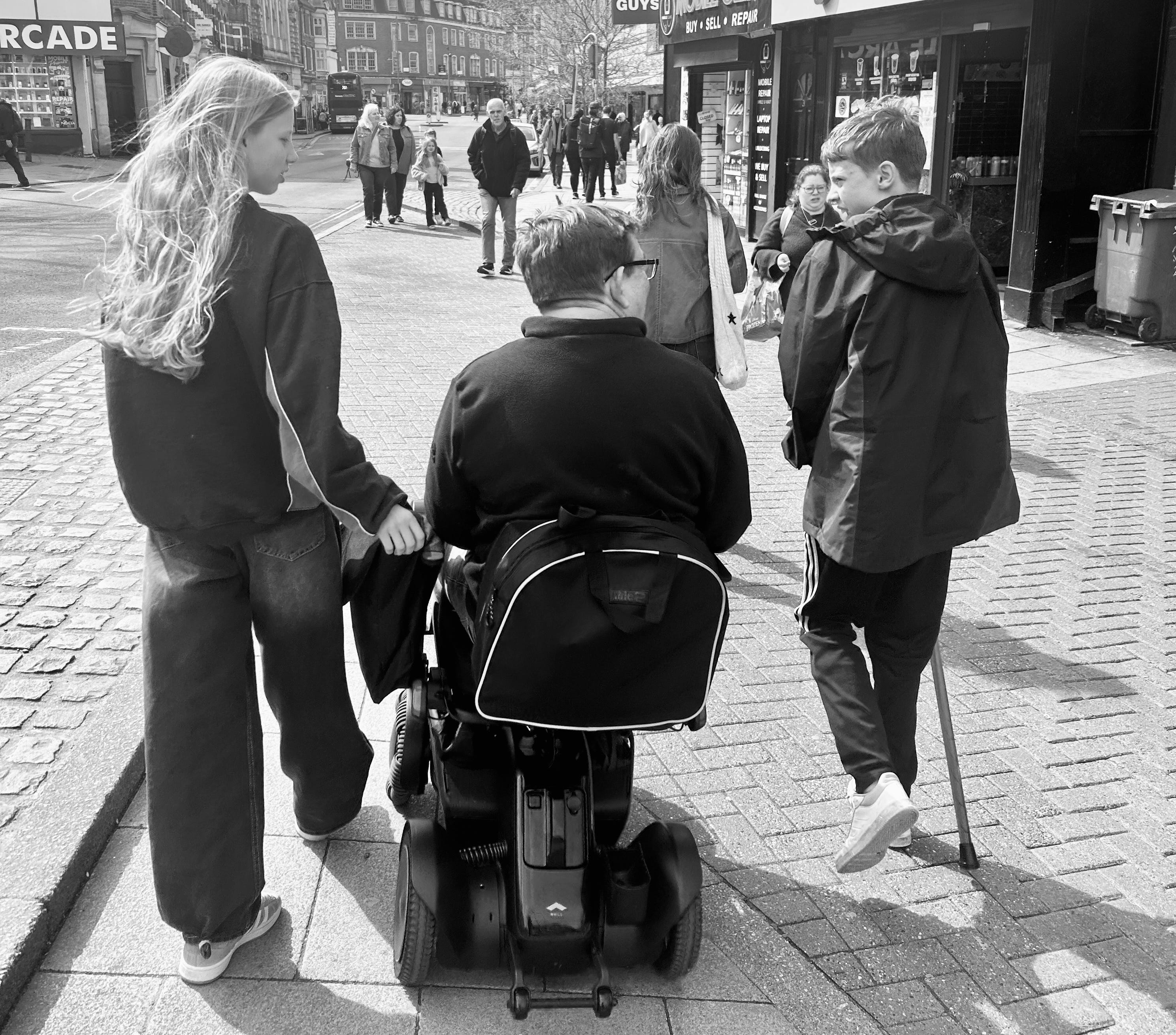
I’ve been grieving recently for a version of myself that I always assumed would remain constant. Not the dramatic things. Not the big headline moments. The smaller ones. The spontaneous ones. The me who could just do things without calculating the cost first. The me who was lighter (mentally and physically), funnier, and more available at short notice. The me who didn’t need to negotiate with his body before saying yes.
Lately, I’ve been grieving something else too: the dad I thought I’d be. Not because I don’t love my children (I do, deeply), but because some days I don’t have the energy to be as active in their lives as I’d like. That kind of grief doesn’t come with a clear moment of loss. It doesn’t arrive with a single before-and-after, no obvious “this is where everything changed” marker you can point to and say, that was the day.
It just shows up again and again on ordinary afternoons.
It shows up in the things I could have done but couldn’t, to make their lives easier. It shows up in the quiet probing every parent does with their teenagers, trying to make sure everything is fine in their world, even when they pretend it isn’t a big deal. It shows up in the background awareness that all of this used to be effortless, and these days, I’m often struggling to keep up.
A life that used to be effortless
Before Long Covid, spontaneity was one of my favourite ways to be alive. I didn’t always plan things properly. I didn’t (mostly) always do things “wisely”. But I lived with a kind of freedom that I didn’t even recognise as freedom at the time, because I assumed it would always be there.
I could decide at the last minute to go somewhere. I could take the kids out without needing to consider how many hours it would cost me afterwards. I could arrange, last minute, to take my lovely wife to the theatre on a cheeky Tuesday evening. I could meet someone, do something, say yes, stay a little longer, push a little harder, and then just go home and recover naturally.
I was the person who would pride myself on being able to lift the mood in a room, raise the energy (ironically). I didn’t realise how much of my joy was wrapped up in that version of me. Not because I needed constant excitement, but because I didn’t have to treat life like an ongoing negotiation. I could just live it.
So yes, I am feeling sorry for myself and what I have lost. I long to live without treating every decision like a trade.
Long Covid didn’t just slow my body down. It has edited my personality. Not because I have become a different person on purpose, but because the boundaries of what I can do are constantly shaping who I am allowed to be.
Am I becoming a “better” person? Sure.
There are benefits to taking the slower, more practical route. But sometimes, like the last couple of days, I miss the old me.
The constant negotiation no one sees
One of the strangest things about chronic illness is that so much of it looks like nothing. From the outside, it can appear like rest, like choosing the sofa, like suddenly being emotionally unavailable. But on the inside, it’s a constant negotiation, and you wake up doing the maths before you’ve even properly opened your eyes.
How much energy do I have today? How much will this cost? How long will the payback last? What will I lose tomorrow if I do this today?
It isn’t that I don’t want to. It’s that my body keeps billing me for things that used to be free. That’s hard to explain without sounding like I'm being dramatic, because “I can’t today” sounds like a preference, but isn’t. Sometimes it’s a warning, and sometimes it’s the moment where you realise your body has limits you can’t fight without consequences.
The grief of a smaller life
There are losses that people understand easily, such as losing their job. Losing someone you love. A sudden trauma that changes everything. But the grief of Long Covid is quieter than that. It’s the loss of your pace, your reliability, your confidence, your ease. It’s the loss of being able to trust your own body to show up when you need it most.
It’s the grief of seeing your life shrink, and having no idea if it will ever expand again. The hardest part is that it isn’t just your body that changes. It’s your relationship with yourself.
Because you remember who you used to be. You remember what it felt like to decide something and then just do it. You remember what it felt like to be the one who coped, the one who didn’t need help, the one who could keep going. So when you can’t do those things anymore, the loss isn’t only physical.
It’s personal.
The dad I thought I’d be
This is the grief that catches me when I’m not expecting it. Parenting is physical, even with teenagers. It’s movement, noise, constant small needs, and those strange moments where something huge has to be talked about right now — usually whilst someone is half-playing a casual game.
With teenagers, the energy isn’t about chasing them around a park. It’s about being available at the right moment, staying calm when emotions flare, asking the next question, and having the capacity to hold what they tell you without crumbling afterwards.
There are days I watch my children moving at full speed, and I feel two things at once: gratitude that they’re well, and grief that I can’t always join them. I want to be the dad who is emotionally and physically present as much as I can be — the dad who says yes without hesitation. Instead, I’m sometimes the dad who has to sit down halfway through, not because I’ve stopped loving them, but because my body has stopped cooperating.
That comes with guilt attached. Not because anyone is telling me I’m failing, but because I can feel the gap between what I want to give and what I’m able to give. When I miss a moment, it can feel permanent.
When your love has to change shape
This is where I’ve had to learn something that doesn’t come naturally to me: that love isn’t only expressed through energy. Love is not just the dad who runs around with a football. It’s also the dad who notices, the dad who listens, the dad who stays.
The truth is, I might not always be able to be the most active parent, but I can still be a present one. I can still read, still talk, still laugh with them, still create small rituals that don’t cost too much. Sometimes it’s not about doing more. It’s about being there.
I don’t say that to make it sound neat or to force a silver lining, because it isn’t neat, and sometimes it doesn’t feel like enough. But it is real, and it counts.
There is a kind of bravery in rest that no one celebrates. Rest doesn’t look like strength. It doesn’t look like resilience. It doesn’t look like winning. It just looks like stopping. But in chronic illness, stopping is sometimes the most responsible thing you can do.
I still miss the old me. I miss the spontaneity, the fun, the ease, and being able to say yes without thinking. But I’m learning that my children don’t only need my energy.
They need my presence.
And as limited as I feel sometimes, I am still here.
Life with Long Covid is more than a few articles; it is also:
A community which you can find at www.lifewithlongcovid.co.uk
A podcast which you can access through the website or through Apple and Spotify, just search for ‘Life with Long Covid’.
I have also produced a short book that details some of my podcasts in short, easily digestible chapters. You can read it when you have the energy. It’s available on Amazon here.
Sales of the book help me with the cost of the podcast and website. You can subscribe to receive the latest articles and episodes in your email inbox. This is free, but there is also the option to pay monthly or annually to receive it. To the people who feel able to support me financially, I am very grateful to you.
"My body keeps billing me for things that used to be free." YES. It's like there is an entirely new economy happening that I didn't even know existed before.